Field notes · Mahj for More
What I Got Wrong Running Our First Charity Mahjong Tournament
On August 29 we ran Mahj for More, a charity mahjong tournament benefiting the Down Syndrome Association of Central Texas at Onion Creek Club in Austin. It went well overall. However, mistakes were made. Hopefully, this article can serve as a template for what to avoid.
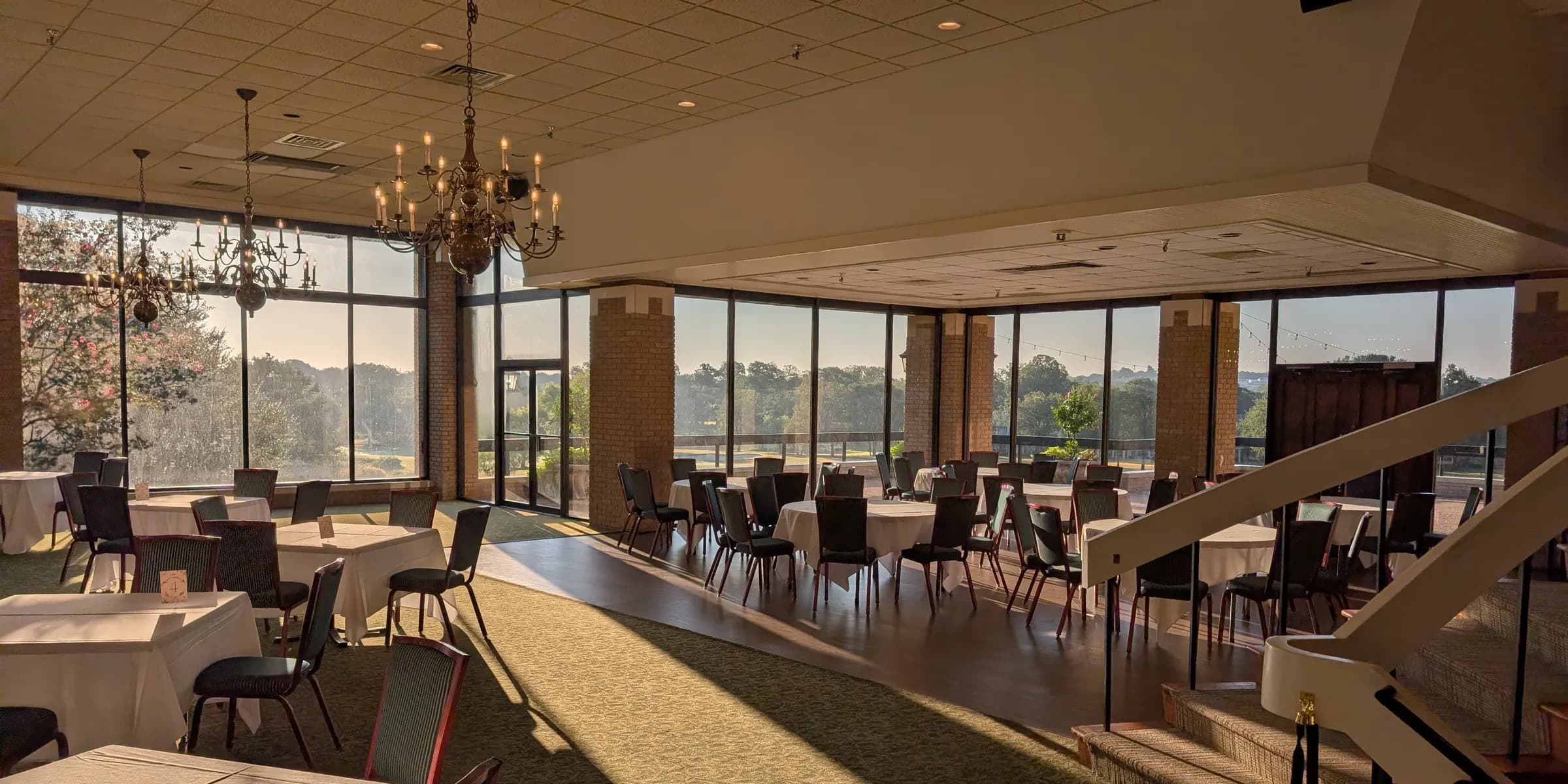
Three sixty-minute rounds, social tables running alongside, lunch, a raffle, and a beautiful, custom-designed trophy. People had a good time, the tournament finished on schedule, and the charity got paid.
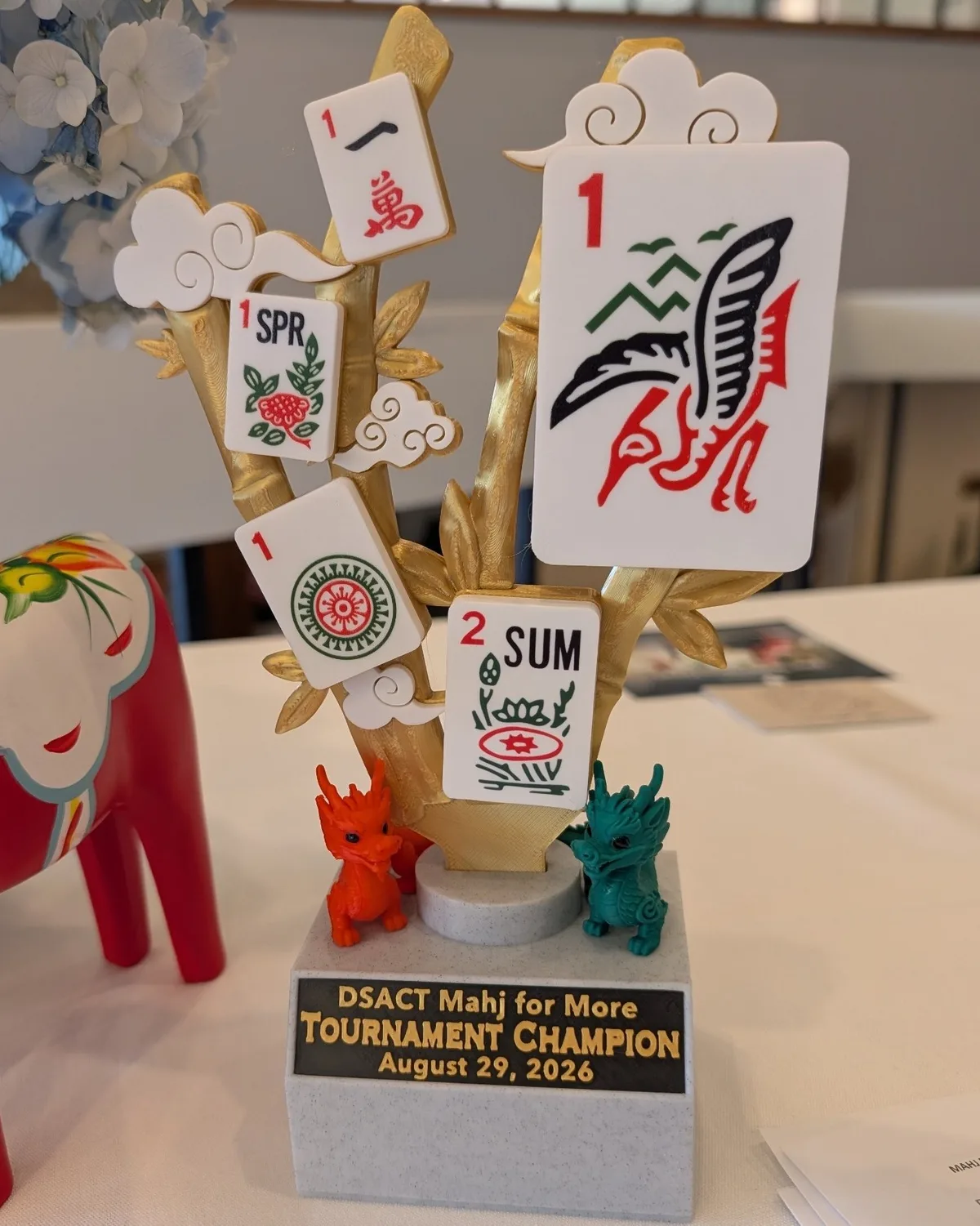
It also went well partly because a few things broke in our favor. I have run events before in a different industry, and I still got things wrong here that I would have told someone else to plan for.
So this is the audit rather than the victory lap. If you are putting together your first tournament, most of what follows is stuff nobody warned me about (as well as a few things I should have known better).
01
The attendance miss was not where I expected
We planned for 60 to 70 players, split roughly evenly between tournament entries and casual social play. What we actually got:
34
Tournament registrations
4
Casual registrations
2
Tournament no-shows
Planned for 60–70 players, split evenly · 38 registered, 36 played
Although it took a lot of time, the tournament side eventually got to where we hoped it would. The casual side… not so much.
I had assumed casual would be the easy sell. It is cheaper, it is lower commitment, and it does not ask anyone to feel competitive. That reasoning was wrong. A tournament sells something people cannot get at home: stakes, a ranking, a trophy, a room full of players they have never sat across from. Casual play competes directly with the free weekly game most of our target audience already has on their calendar. It also put us in competition with every other open play event around the city, which typically have much smaller ticket prices.
If you are running a two-track event, do not assume the social tier carries itself. It is the harder sell of the two (at least for us).
02
Everything has to divide by four
Mahjong seats four. That sounds obvious, and it is, right up until you are standing in a ballroom trying to figure out what to do when the 33rd tournament player arrives.
Thirty-four tournament registrations gives you eight full tables and two players left over. To seat those two you need a ninth table, which means finding two more bodies, and my only source was my wife/co-host and the four casual players. Pulling two of them would have left two casual players who could not field a table either.
At 10am we had three players missing. That put us at thirty-one, one short of eight full tables. Luckily, one of our casual players had expressed interest in joining the tournament and was happy to step in. Then, right as we were about to begin, one of the three arrived after all. Luckily, our gracious casual sub was happy to jump back over to the casual table. Otherwise, we would have been scrambling to add another table, fill the remaining seats, and recalculate remaining table assignments.
Lesson learned — bring more subs, and have an extra table ready to go.
03
I thought I had arrived plenty early… I was wrong.
I arrived at 7:50 for a 9:30 check-in. That felt like plenty. Here is how the morning actually ran:
- 7:50Arrived and started unloading.
- 8:20The first guests arrived to set up their tiles — seventy minutes before check-in was meant to open.
- 9:30Check-in officially opened, with many guests already in the room.
- 10:00Scheduled start.
- 10:05Last player walked in.
While I was able to get everything unloaded, set out table numbers, arrange the raffle items, and get my laptop set up for check-in before the first people arrived, I did end up a bit rushed, and things got more hectic than they needed to.
Then people started showing up early. We had asked people bringing equipment to show up before checkin, but didn’t give a specific time. In a normal event setup, this wouldn’t be as big of a deal. You acknowledge the early arrivals and continue getting set up prior to opening check in. However, since these early arrivals needed to know which tables to set their equipment up on, I had to go through the full check-in process before I was fully prepared.
So I spent the morning context switching between four jobs, over and over, per table, while more people kept walking in. Check the person in. Assign them a table. Make sure East was logged into the scoring system. Make sure East understood how to use it.
Early in the process, I accidentally hit a “check in all” button and spent a few minutes unwinding it. I have since removed said offending button.
04
Two volunteers showed up, and I could not fully utilize their help
We had two volunteers besides my wife Sara and me: a friend and a DSACT employee. Both willing, both capable, both unable to help where I needed it most (registration and table assignment).
I never found a moment to train them, because finding that moment meant stopping, and stopping meant the check-in line grew. So I powered through and let them help in other ways (taking payment for raffle tickets, greeting guests, taking pictures, etc. — all helpful in their own right, but not what was the most immediate need).
This is the lesson I would most want a first-time organizer to take. If roles are not defined and briefed before the doors open, extra people add to your load instead of reducing it. Name the stations, name the person on each one, and brief them the day before or at minimum thirty minutes before doors. Never during.
Unassigned help is not help.
05
Nobody does the pre-work, so design for that
We emailed every attendee ahead of time letting them know scoring would be handled digitally. Not one attendee practiced with it beforehand. The only person in the room who had touched it before was my amazing 12-year-old daughter :) She had used the scoring system for the final tournament of the Mahjong camp she hosted over the summer, so she was able to help out on the IT front.
I do not say that as a complaint. It is just what happens, and any plan that depends on attendees preparing is not a plan.
What saved us was training East only. One person per table instead of four cuts the training load by seventy-five percent, and East walks their own table through it. Every table got through every round, and when they had questions, we had the resources to help them out quickly.
Assume every single person walks in cold.
06
We botched some email stuff
The reply-to address on our event emails was wrong. An in-kind donor tried to respond and got error messages back. She was gracious enough to bring her raffle donation anyway (thank you, Bougie Bams!), but I missed the conversation entirely and had no idea it had happened.
The automated reminder email did not include the venue address or arrival details. My own know-before-you-go email did, but the automated reminder is the one that landed closest to the event, which makes it the one people actually read. Our late arrival cited it as the reason, and I have since updated future reminders to provide all of the critical details that were missing.
Send yourself the real delivered messages, not the templates, and read them as a recipient before the event.
The common thread is that automated email fails silently. Nothing bounces, nobody complains, and you have no idea anything is wrong.
07
Have a sub ladder, and know what each rung costs
Right before we started, a player found her set was missing a tile. We had a spare set and swapped it out quickly.
For the seating scramble above, I did have a contingency plan, ranked in order of what I was willing to give up. Sara first. Then our other volunteer, who was playing. And the option I intended to avoid at all costs, which was pulling my daughter out of the tournament she was competing in and moving her to casual.
That is the honest shape of a sub plan at a small event. Every person on my ladder already had a job. It was not spare capacity; it was a ranked list of what I would break and in what order.
So make sure you have subs and contingencies for a range of total attendance.
08
Don’t assume the venue will provide everything you need
The staff at Onion Creek were genuinely great, and this is not about them. It is about the gap between what you assume is included and what actually is.
We paid for a projector. I assumed a power strip/extension cord came with it to plug in our laptop. It did not. There was also no gaffer tape, so the cord ran loose across the floor and someone stumbled over it. That one could have gone badly, but luckily no one got hurt.
The laptop wanted to go to sleep, since it was not plugged in, so I was jiggling the mouse throughout each round and letting it charge at lunch.
Put your AV and power requirements in writing in the contract, then bring your own kit anyway. Power strip, extension cord, gaffer tape, chargers, and turn off every sleep setting the night before.
The box that now lives in the car
- Spare tile set
- Power strip
- Extension cord
- Gaffer tape
- Chargers
09
The small hospitality things are what people remember
I made sure lunch had gluten-free options for an attendee with a sensitivity. I forgot to check dessert. That is the part she will remember, and it would have cost nothing to prevent.
That is not a logistics failure; it is a hospitality failure, and those land harder than a five-minute delay ever will.
10
The money
It is extremely difficult to estimate attendance for a completely new event. We did our best and honestly leaned towards the aggressive side.
Because we picked the venue against that aggressive number, our cost per head came in higher than it should have. What kept us out of trouble was that the tier that sold was the premium one. Tournament entries carried the room.
I would still pick Onion Creek again. The room suited the format, the staff handled a lot of small things without being asked, and the setting made the day feel like an occasion rather than a fundraiser in a rented hall. When you are asking people to give up a Saturday and open their wallets, that matters more than the per-head math suggests.
So the lesson is not “budget conservatively.” It is budget against your revenue mix, not your headcount.
What we are changing
Named volunteer roles, briefed the day before, with a written run of show that includes the announcements I keep forgetting to make.
Arriving substantially earlier and staffing check-in as if guests will turn up an hour before the posted time, because they will.
Reading every automated email as a recipient before the event goes out.
A physical kit that lives in one box: spare tile set, power strip, extension cord, gaffer tape, chargers.
And rethinking the casual tier completely. It did not work as a revenue line, and we’ll need to think whether to double down, or remove the casual tier entirely for next time in favor of a sub pool that can play casually if not needed.
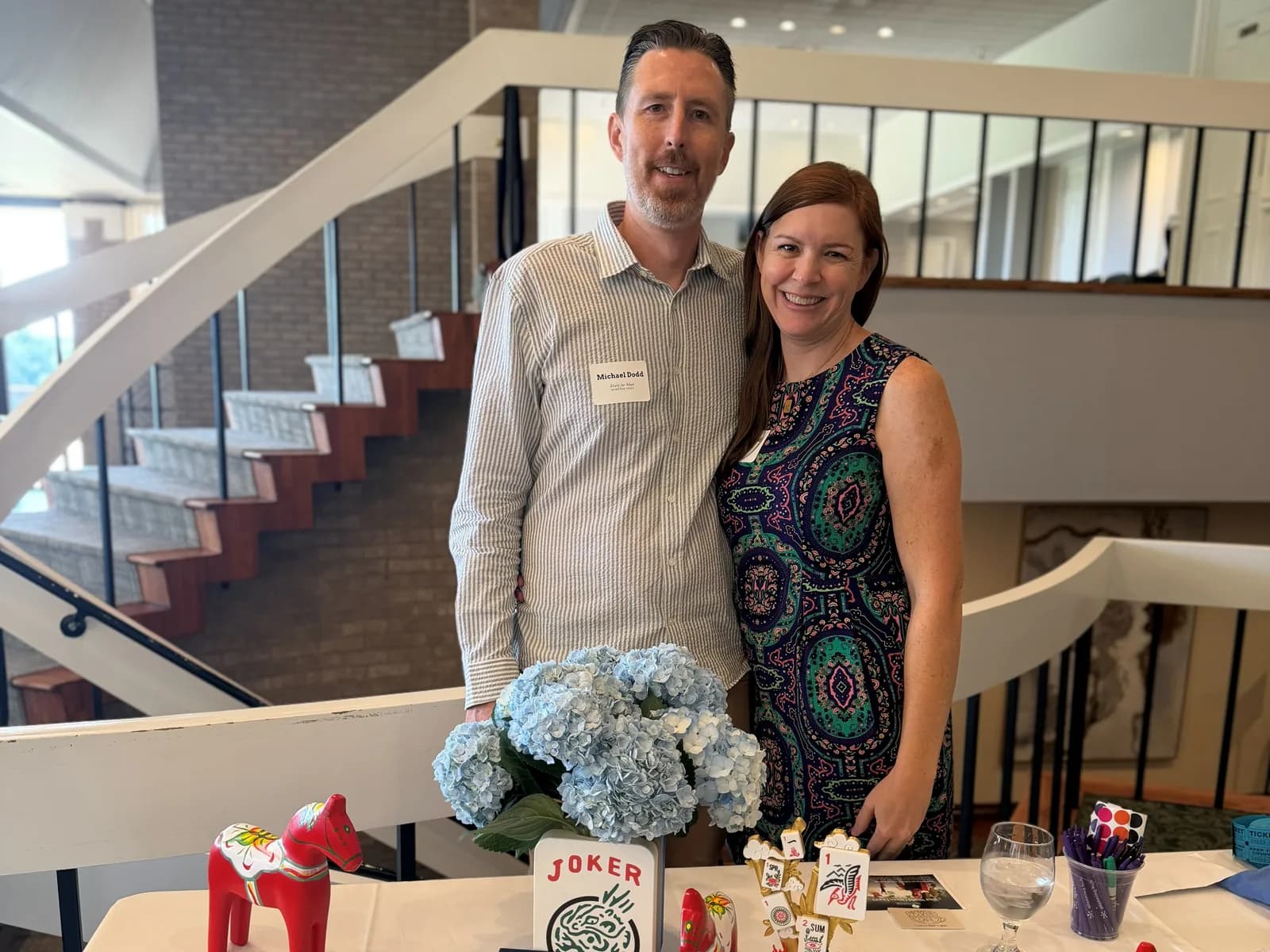
The organizers
If you are planning your first tournament and want to compare notes, I am easy to find. I would rather you learn this from my morning than from your own.
Michael and Sara Dodd at the welcome table, Onion Creek Club.
Keep going
Running your first tournament?
Check-in, table assignments, and digital scoring — the parts that cost me my morning.
Last updated September 4, 2026.